Security deposits for a rental shop: how much to take, and how to give it back
How much security deposit to take on a rental in India, what it should cover, how to handle ID, UPI and late fees, and how to settle it at the return without an argument. For clothing, bike, camera and equipment hire.
· 11 min read
On this page
- The short answer
- What a deposit is actually for
- How much to take
- Decide what it covers, and say so before handover
- Photograph it at handover
- ID: what to collect, and what not to keep
- Cash or UPI?
- Settling it at the return
- When a customer disputes a deduction
- A note on GST
- How ProRentify handles deposits
- Questions people ask
The short answer
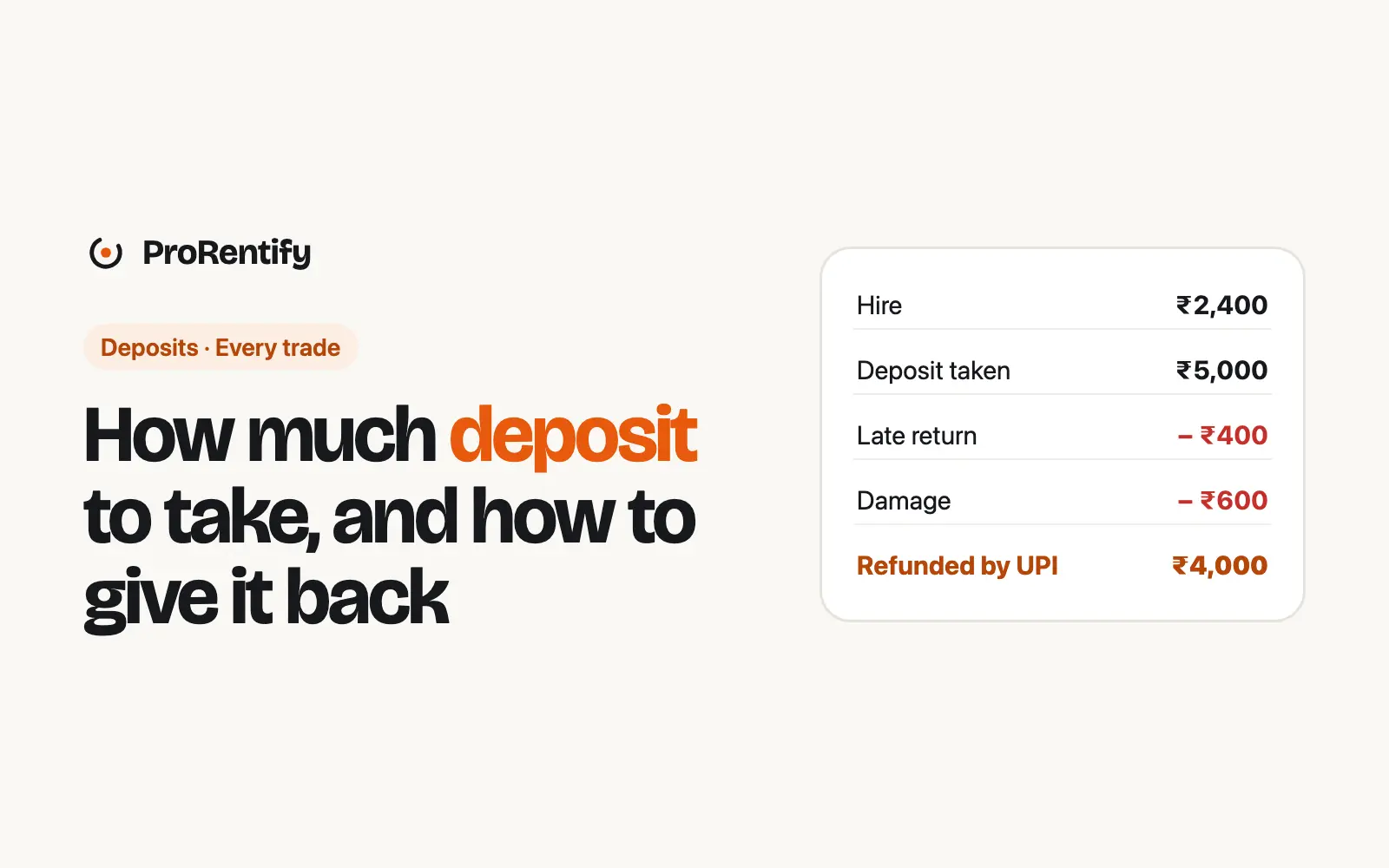
Take a deposit that is big enough to cover the damage you actually see, not the full price of the item, and write down before anything leaves the counter what it covers and when it comes back. For most shops that means 20–50% of what it would cost to replace the piece. Go higher for small, expensive things that are easy to walk off with, like lenses, jewellery sets and designer lehengas, and lower for regulars and bulky stock. Take it before handover, by UPI where you can, and settle it on the day the item comes back: what was owed comes out first, and the rest goes back the same day.
The rest of this guide covers how to set the figure, what a deposit should and should not cover, how ID fits in, and what to do when a customer argues about a deduction.
What a deposit is actually for
A deposit is not insurance against losing the item. On a ₹1.5 lakh camera body no customer will leave you ₹1.5 lakh in cash, and if you ask for it you lose the booking to the shop down the road. What a deposit does is:
- Make the customer careful. Money of their own on the line changes how a lehenga is worn at a sangeet, or how a scooter is parked overnight.
- Cover the everyday costs. A stain that needs specialist cleaning, a missing lens cap, a scratched panel, a day late. These are the charges that eat a rental shop's margin, and they are the ones a deposit is sized for.
- Bring the item back on time. Someone who has ₹5,000 waiting at your counter returns on the day.
The rare total loss, where a bike is stolen or a camera is dropped in the sea, is not handled by a deposit. It is handled by your ID check, your rental agreement and, for vehicles and high-value gear, insurance. Size the deposit for the common case.
How much to take
There are three common ways to arrive at the figure, and most shops use more than one.
A share of the item's value
Give every product a deposit value, usually around what it would cost you to repair or replace the parts that most often go wrong, and take that or a percentage of it. Some starting points:
- Bridal and designer wear: 30–50% of what you paid for the outfit. A lehenga that cost you ₹60,000 might carry a ₹20,000–₹25,000 deposit. Jewellery sets sit at the top of the range because they are small and easy to lose a piece of.
- Sherwanis, suits and gowns: 20–40%. Mostly you are covering cleaning, alterations gone wrong and missing accessories such as stoles, safas and brooches.
- Cameras and lenses: often the highest, because the gear is small and valuable. Many shops take a flat sum per kit plus ID, and ask for more from first-time customers.
- Bikes and scooters: a flat amount per vehicle type, for example one figure for a scooter and a higher one for a 350cc motorbike, plus the rider's driving licence.
- Event and equipment hire: a lower percentage, since the customer is usually a business and the stock is bulky. Instead, count it out and count it back in.
These are starting points, not rules. Look at your last few months of damage and late charges: if your deposits never ran out, you can lower them and win more bookings; if you keep chasing customers for money after the deposit is used up, raise them.
A share of the hire
Some shops take a deposit equal to a share of the hire total, for example 50% or 100% of the rent. It is simple to explain, but it ties the deposit to the price rather than the risk. A ₹2,000 hire of a ₹40,000 lens gets a tiny deposit. Use it for low-value stock, not for your best pieces.
A flat amount
A fixed ₹2,000 or ₹5,000 per booking is easy to say at the counter and on WhatsApp. It works well for shops whose stock is all of a similar value, like a scooter fleet or a costume shop.
Adjust for the customer
The deposit is also where you price trust. A wedding planner who has hired from you twenty times can leave less. A first-time customer who found you on Instagram, wants the most expensive piece and asks for delivery to another city should leave more, or should come to the counter.
Decide what it covers, and say so before handover
Most deposit arguments are not about money. They happen because the customer did not know the rules. Before anything leaves the shop, the customer should know:
- What counts as damage. Normal wear is yours to absorb. A wine stain, a torn hem, a cracked filter or a dented mudguard is theirs. Write down the common ones with rough prices, such as "specialist stain removal from ₹800", so a deduction is not a surprise.
- What a late return costs. The simplest rule is the item's own rate for every hour or day it is late, with a short grace period. If a scooter is due at 6 pm and comes back at 6:10, let it go. At 8 pm it is two hours late.
- When the deposit comes back. Same day at the counter is best. If you inspect the item first, for example by sending a lehenga to the dry cleaner before you check for stains, give a fixed number of days and keep to it.
- How it comes back. The same way it was paid is the cleanest. A UPI deposit goes back by UPI to the same number, so the refund leaves a record.
Put this on the booking slip or in the rental agreement, and send it on WhatsApp when the booking is confirmed. "It was in the terms" works much better when the customer has the terms on their phone.
Photograph it at handover
A deduction is only as strong as your proof that the damage was not there before. Take two or three photos of each piece as it goes out, in good light, showing the parts that usually get damaged: the hem and dupatta of a lehenga, the front element of a lens, the sides and tank of a bike. Take the same photos when it comes back. Keep them with the booking, not loose in a staff member's phone gallery, so anyone at the counter can find them a week later.
Do the checks together at the counter. Unfold the outfit or switch the camera on while the customer is standing there. Everything that is fine is agreed on the spot, and anything that isn't is discussed while you are both looking at it, not over WhatsApp three days later.
ID: what to collect, and what not to keep
A deposit covers small losses; ID is what lets you find someone after a large one. Most Indian rental shops ask for a government photo ID, and bike shops also need the rider's driving licence.
Some practical points:
- Check the original, keep a copy. Look at the original card, match the face and take a photo of it for the booking. Holding a customer's original Aadhaar or licence at the counter is common, but it is a document you are then responsible for, and a rider stopped by the police without their licence is a problem for them and for you.
- Prefer masked Aadhaar. UIDAI lets anyone download a masked Aadhaar that hides most of the number. It identifies the customer without you storing a number you don't need.
- Store it privately. ID photos are personal data under India's Digital Personal Data Protection Act. Keep them in one place, with access limited to your shop, and don't keep them longer than you need.
- Match ID to phone number. In India the phone number is the customer's real identity at a rental counter. Look customers up by number so you can see a repeat customer's past bookings, and any damage, before you agree the deposit.
Cash or UPI?
Cash is still common and customers like it, but it is the easiest to lose track of. Cash from three bookings sits in one drawer, a staff member hands back the wrong amount, and at month end nobody can say how much of the drawer is customers' money.
UPI leaves a record on both sides and is easy to refund to the same number. It is the best default for most Indian shops.
However it is paid, record the deposit against the booking separately from the rent. The single most common deposit problem is not knowing which money in the till belongs to customers.
Settling it at the return
When the item comes back:
- Check it against the handover photos, with the customer present.
- Add any charges: damage, late return, missing accessories. If you are waiving a twenty-minute delay for a regular, do it consciously, not by forgetting.
- Take what is owed from the deposit first. That means charges, then any rent still unpaid.
- Give back the rest the same way it came in, and note how it was returned.
- Keep a damaged piece off the shelf until it is repaired or cleaned, so it is not handed to the next customer.
If the charges are more than the deposit, collect the difference now, while the customer is at the counter and the photos are in front of you.
When a customer disputes a deduction
Some will. Have the conversation in this order:
- Show the handover photo, then the return photo. Most disputes end here.
- Show the price you wrote down for that kind of damage before handover.
- If it is a judgement call, like a faint mark or fifteen minutes late, consider splitting it with a good customer. A repeat booking in the next wedding season is worth more than ₹500.
- Write down what was agreed on the booking, so the next person at the counter knows.
A note on GST
A refundable deposit that you give back is generally not treated as payment for a service, so it is not part of your taxable value. A late-return charge is extra rent, so it is part of your supply and attracts GST like the hire itself. Money kept for damage, or a deposit forfeited outright, is less clear-cut: CBIC Circular 178/10/2022 treats forfeited deposits and compensation as generally not payment for a service, unless the contract makes them one. If you are GST-registered, record the money you keep as a charge on the booking rather than quietly holding back cash, and confirm the treatment for your business with your CA.
How ProRentify handles deposits
ProRentify is rental software built around this way of working. On each booking you choose how the deposit is worked out: none, a percentage of the hire total, a percentage of the deposit values set on the products, or a fixed amount. The deposit is recorded separately from the rent, so you can see what is customers' money held. You can keep a photo of the customer's ID with their record, stored privately for your shop, and photograph each piece at handover.
At the return, late fees are suggested from the item's own rate after your shop's grace period, and you can change or waive them. Damage is added as a charge. The deposit pays charges and any unpaid rent first, and the rest is refunded, with a note of whether it went back by cash, UPI, card or bank transfer. A damaged piece is held back from new bookings until someone clears it.
There are pages for clothing and costume rental, bike and scooter rental, camera and lens rental and event and equipment hire. The free plan needs no card. See pricing for when the paid plans make sense.
Questions people ask
Should I take the full value of the item as a deposit?
Rarely. Customers won't leave it, and you will lose bookings. Size the deposit for common damage and late returns, and rely on ID, a signed agreement and insurance for the rare total loss.
Can I keep the whole deposit if an item comes back late?
Only if you told the customer that before handover, and even then it rarely feels fair. Charging the item's own rate for the extra time is easier to defend and keeps the customer coming back.
How quickly should I refund a deposit?
The same day if you can check the item at the counter. If it needs cleaning before you can inspect it, set a fixed number of days, tell the customer at booking, and keep to it.