How to start a camera rental business in India
What to stock first, what it costs, how to price a camera or lens per day, and how to handle deposits, ID, damage and GST, with the sums in rupees. A practical guide for a new camera rental shop in India.
· 10 min read
On this page
The short answer
To start a camera rental business in India, begin with a small kit that local shooters already ask for: one or two full-frame mirrorless bodies, a 24–70mm, a 70–200mm, a fast prime, a gimbal, batteries and cards. Bought used, or with third-party lenses, that is roughly ₹4–6 lakh of gear; all new from the camera makers, expect well over that. Price each item at about 1–2% of what it would cost to replace, per day. Take a deposit and an original ID for every hire. Photograph every piece as it leaves and as it comes back. Register your shop under your state's Shops and Establishments Act, and register for GST once turnover nears ₹20 lakh. The rest of this guide covers each step, with the sums.
Who rents cameras, and when
Before you buy anything, know who will walk in. In most Indian cities the steady renters are:
- Wedding photographers and videographers. They own a kit, but rent a second body, a long lens or extra lights for big functions. Their demand follows the wedding season: busy from November to February, with another rush around April and May.
- Content creators and YouTubers. They rent to try a body before buying it, or for a single shoot that needs more than their phone.
- Film and media students. Short films, college fests and final-year projects. They are price-sensitive, so they want weekends and longer hires.
- Small production houses and ad shoots. Fewer hires, but bigger orders: cinema cameras, lights and audio for two or three days.
- Travellers. A long lens for a safari or a trek, often for a week.
Each group wants different gear and different terms. Wedding shooters book weeks ahead and come back for the same lens. Students turn up on Friday evening. Decide which two groups you will serve first, and buy for them.
What to stock first
Popular, compatible gear rents far more than rare gear. Pick one main mount, usually Sony E-mount today, with Canon RF second. Buy lenses that fit it, so every lens can go out with every body.
A sensible first kit:
| Item | Why it rents |
|---|---|
| 2 full-frame mirrorless bodies | Weddings and creators both want them; two lets you cover a booking when one is in for service |
| 24–70mm f/2.8 | The everyday zoom for events |
| 70–200mm f/2.8 | Stage, sports, weddings, wildlife |
| 50mm or 85mm prime | Portraits and pre-wedding shoots |
| Gimbal | Video creators and wedding films |
| 2 LED lights with stands | Interviews and product shoots |
| Wireless mic kit | Creators always forget audio |
| Spare batteries, chargers, cards | Small to buy, and every hire needs them |
Buy second copies of whatever rents most before you buy anything new. A third body earns more than a cinema lens that goes out twice a year. Keep a waiting list of what people asked for and you didn't have. After three months, that list is your next purchase.
Used gear is fine if you check the shutter count, the sensor, the lens glass and the mount, and get a bill. Without a bill you cannot claim GST input credit, and you have no proof of ownership if something is stolen.
What it costs to start
A worked example for a one-person shop renting from home or a small counter:
| Cost | Rough amount |
|---|---|
| Starter kit (table above) | ₹4,00,000 – ₹6,00,000 |
| Cases, bags, cleaning kit, sensor swabs | ₹15,000 – ₹30,000 |
| Equipment insurance (yearly) | ask insurers; budget a few percent of the gear's value |
| Shop and Establishment registration, GST registration | small government and CA fees |
| Website, listings, photos | ₹0 – ₹20,000 |
These are planning numbers, not quotes. Check current prices with dealers and second-hand sellers in your city. The figure that matters is the gear. Everything else is small next to it, so don't overspend on a showroom before you have regulars.
How to price a camera hire
Look at what other rental shops in your city charge first. Most Indian rental sites publish a day rate for every item, and you will see a consistent pattern: roughly 1–2% of the item's replacement value per day. A ₹1,50,000 lens at ₹1,500–2,000 a day is normal. A ₹2,00,000 body at ₹2,000–3,000 a day is normal.
Then add the rules that make the price work:
- A minimum hire. One day, or 24 hours, even if the customer only needs it for the evening.
- Cheaper longer hires. A week is often priced at four or five days, so the gear doesn't sit idle.
- Weekend rates. Friday evening to Monday morning, priced as two days, is popular with students and creators.
- A buffer between hires. Batteries need charging and sensors need checking. Don't book a lens out at 10am when it only comes back at 9am.
The payback sum. Suppose a ₹1,60,000 lens rents at ₹1,800 a day. If it goes out 8 days a month, that's ₹14,400 a month. It pays for itself in about 11 months, before costs. At 4 days a month it takes nearly two years. So the number to watch is not your rate but utilisation: how many days each piece is actually out. Track it per item, and sell what doesn't move.
Deposits, ID and damage
This is where camera rental differs from most rental trades. The gear is small, expensive and easy to resell. Your process at the counter protects you more than your contract does.
ID. Take an original photo ID and keep a copy: Aadhaar, driving licence, voter ID or passport. Prefer a masked Aadhaar, which hides all but the last four digits, so you aren't storing a full Aadhaar number you don't need. For a first-time renter taking expensive gear, many shops also ask for a second document, a local address, or a reference from a photographer they already know.
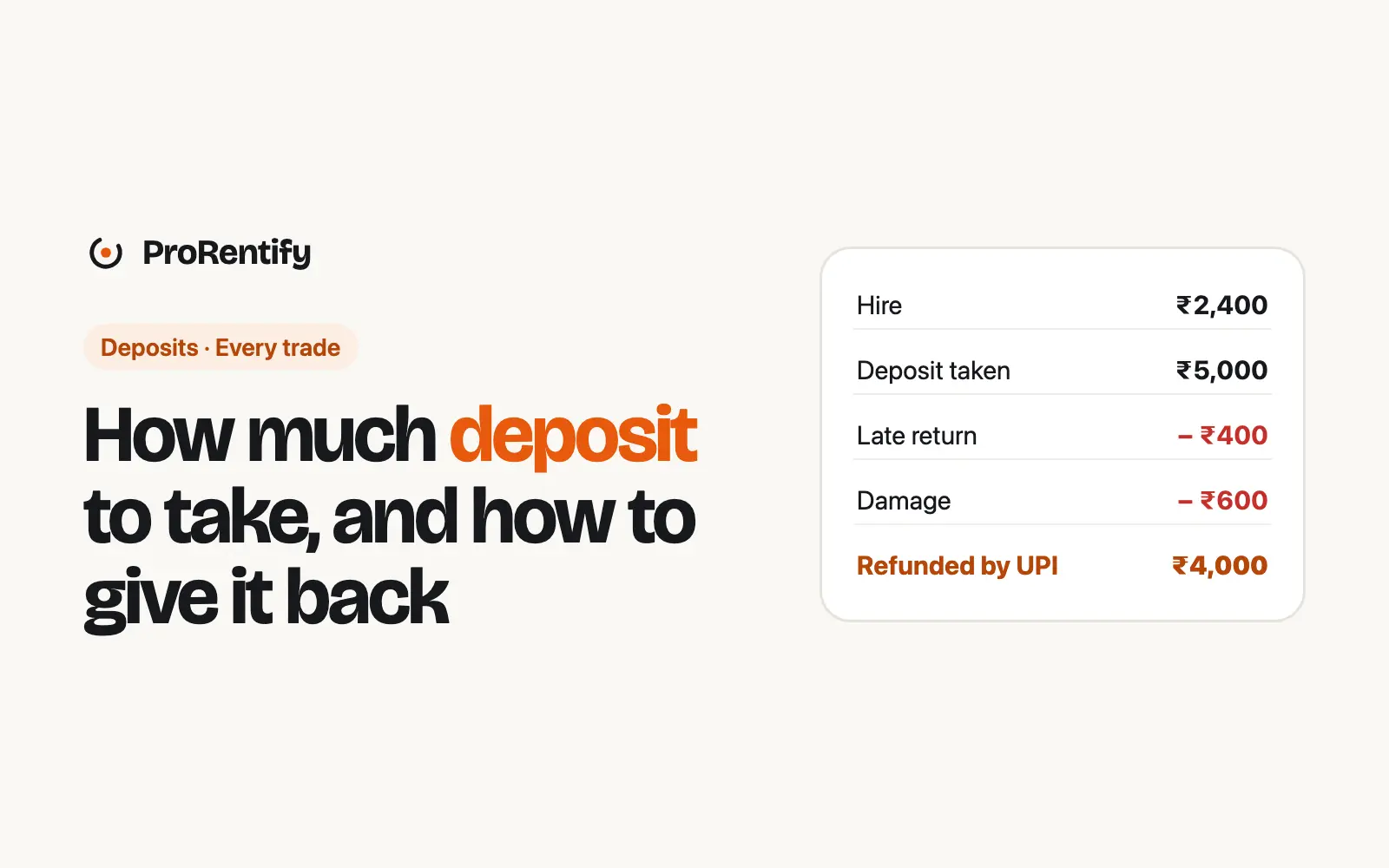
Deposit. Shops commonly take a fixed deposit (₹5,000 is common for a single body or lens) or a share of the gear's value for big orders. Take it by UPI so there's a record, and say before handover what it covers: damage, missing parts, late return. Our guide to security deposits for a rental shop covers how much to take and how to settle it at the return without an argument.
Condition at handover. Photograph each piece as it leaves: front and rear glass, mount, screen, body corners, serial number. Do it in front of the customer. When a lens comes back with a scratch, the photo settles who did it in seconds.
At the return. Check every piece before the customer leaves, not later that evening. Fire the shutter, look at the glass against light, count batteries and caps. If something is damaged, keep that piece off the shelf until it has been looked at. Never rent it out "as is" to the next customer.
Insurance. Ask general insurers about an all-risk or portable equipment policy, and read what it says about gear in a renter's hands. Many policies exclude it. The deposit and your handover photos are your first line, not your last.
Registration and GST
Most new camera rental shops need:
- Shops and Establishments registration under your state's act, if you have premises. Rules and fees differ by state, and many states now register online.
- Udyam registration. It's optional and free, and useful for MSME schemes and bank loans.
- GST registration once your yearly turnover crosses ₹20 lakh (₹10 lakh in special category states), or earlier if a production house or agency asks for a GST invoice.
Renting out equipment without an operator is taxed at the rate that applies to selling the same goods. For cameras that has generally meant 18%. Confirm the current rate and SAC code with your CA before you print your first invoice. Rates were rationalised in 2025, and rental of goods has its own rules.
Running the counter without double-booking
A camera rental business usually breaks down in the same three places once it gets busy:
- The same lens promised twice. Two inquiries on WhatsApp for the same Saturday, and both get a yes.
- Not knowing which copy went where. You have two 70–200s; one came back with a sticky zoom ring, and you can't say which shoot it came from.
- Deposits nobody can account for. Cash in a drawer, UPI on the owner's phone, and refunds done from memory.
A notebook or a shared spreadsheet works at the start. Our comparison of notebook, WhatsApp or rental software explains when it stops working. For camera gear, that point usually comes early, because each piece is worth so much.
ProRentify's camera rental software is built for exactly these jobs:
- Every body and lens by its own code. Two copies of the same lens are two pieces, so you know which went to which shoot. One booking can hold a body and the lenses that go with it.
- No double-booking. The database refuses a second booking for a piece that is already out for those dates. You can also set a turnaround time between hires, for checking and charging.
- Hourly, daily, weekly or per-hire pricing, set on each product.
- Condition photos at handover, kept with the booking.
- A swap when gear fails on a shoot. Swap the lens for another copy on the same booking, with no cancelling and rebooking.
- ID documents and the deposit on the customer's record. You can take a fixed deposit, a percentage of the hire total, or a percentage of each item's deposit value.
- Settling at the return. Mark each piece fine, damaged or needing service. A damaged piece is held off the shelf. Damage and late charges come out of the deposit, a late fee is suggested from the item's own rate after your grace period, and you record how the refund was paid (cash, UPI, card or bank transfer).
- Email reminders to the customer before pickup and return, and when a return is overdue.
There is a free plan, free for good with no card needed, sized for trying a whole hire from booking to return. Reminders and a bigger catalogue come with the paid plans, so move up as the kit grows. See pricing for what each plan includes.
A first-month checklist
- Pick your two renter groups and your main mount.
- Buy the starter kit, with bills, and give every piece a code on a label.
- Write one page of rental terms: minimum hire, late fee, what the deposit covers, ID required.
- Photograph every piece in good light; you'll use the photos for listings and condition records.
- List on Google Business Profile, and tell local wedding photographers and colleges.
- Set your day, weekend and weekly rates against what other shops in your city charge.
- Track utilisation per item every month, and buy your next piece from the waiting list.
Camera rental rewards care more than size. A small kit that's always clean, charged and on time will fill up with regulars before a big kit with sloppy handovers does.