How to start a tent house business in India: cost, rates and profit
What it costs to start a small tent house, what to charge per chair, table and shamiana, and the profit worked out per function and per year. Plus breakage, deposits, GST and wedding dates, with the sums in rupees.
· 9 min read
On this page
The short answer
You can start a small tent house business in India for roughly ₹2.8–4.7 lakh: three or four shamiana sets, about 200 chairs, 30 tables, fans, lights, carpets and a rented godown, with transport hired per trip. A 150-guest function on that stock might bill around ₹12,750 and leave about ₹6,200 after transport, labour, cleaning and breakage. At around 66 functions a year, that covers a ₹10,000 monthly overhead and pays back a ₹3.75 lakh start in about 15 months, before your own pay, loan interest and tax.
Those sums are worked out below so you can put your own city's rates in. What decides the profit is how many wedding dates your stock can cover, and how much of it comes back.
What a tent house rents, and to whom
A tent house (also called a shamiana, pandal or mandap business) hires out what a function needs for a day or two. Most start with one of two models:
- Bare hire. The customer takes chairs, tables and fans, and you deliver and collect. Less labour, smaller bills, more small bookings.
- Setup and hire. Your team puts up the shamiana, lays the carpet, wires the lights and takes it all down. Bigger bills, but you need reliable labour on the same dates as everyone else.
Weddings are the big money, but they bunch up on the same auspicious dates. Birthdays, engagements, pujas, school functions, political meetings and office events fill the days between. A tent house with no weekday customers sits idle for most of the year, so look for those early.
What it costs to start
A worked example for a small shop that can serve one 150 to 200-guest function at a time:
| Item | Rough cost |
|---|---|
| 3–4 shamiana sets with side walls | ₹80,000 – ₹1,50,000 |
| 200 plastic chairs | ₹40,000 – ₹80,000 |
| 30 folding tables with cloths | ₹28,500 – ₹40,500 |
| 10–15 fans | ₹15,000 – ₹22,500 |
| Lights, wiring and a distribution board | ₹20,000 – ₹50,000 |
| Carpets and daris | ₹15,000 – ₹25,000 |
| Poles, ropes and tools | ₹30,000 |
| Godown, first three months | ₹15,000 – ₹30,000 |
| Cash for labour and transport | ₹40,000 |
| Total | ₹2,83,500 – ₹4,68,000 |
These are planning figures, in line with published 2026 tent house guides and project reports, which put a small setup at about ₹2.5–4 lakh. Get quotes from two wholesalers in your city before you spend.
Three things to leave for later:
- A vehicle. Hire a tempo per trip until you are paying for more than you would on an EMI.
- A generator. Sub-hire one and add a margin until you need one most weekends.
- Crockery. It breaks, it needs washing, and it takes space. Add it when customers keep asking.
If you apply for a bank loan or Udyam registration, the NIC 2008 code for renting tents, furniture, crockery and utensils is 77291. A newer NIC 2025 list exists too, so check which version the form asks for. For the business code in your income tax return, ask your CA: the list changes between years and a wrong code can bring a notice.
What to charge
Published rates vary a lot by city and quality. One Hyderabad tent house lists a plastic chair at ₹10 a day, a table with a frill cover at ₹180, and a shamiana from ₹1,000. A 2026 business guide uses ₹30 a chair and ₹100 a table. Call five tent houses near you as a customer and write down what each one quotes, with and without setup.
Then check each item pays for itself:
- A chair that costs ₹300 and rents at ₹12 needs 25 hires to earn back its price.
- A table that costs ₹1,000 and rents at ₹150 needs 7 hires.
- A shamiana set that costs ₹30,000 and rents at ₹2,000 needs 15 hires.
Tables and shamianas pay back quickly. Chairs take longest and are what customers count first, so don't buy fancy chairs until plain ones are out every weekend.
Charge separately for transport, setup labour, late-night dismantling and upper floors without a lift. Fold them into the chair rate and the far-off booking loses money while the near one looks expensive. If you price per event rather than per day, say how many days it covers: one price for "the wedding" turns into four days when the family keeps the chairs for the reception.
The profit, worked out
Here is one 150-guest function:
| Line | Sum | Amount |
|---|---|---|
| Chairs | 150 × ₹12 | ₹1,800 |
| Tables | 15 × ₹150 | ₹2,250 |
| Shamiana sets | 2 × ₹2,000 | ₹4,000 |
| Fans | 8 × ₹150 | ₹1,200 |
| Lights | flat | ₹2,500 |
| Carpet | flat | ₹1,000 |
| Bill | ₹12,750 | |
| Tempo, two trips | −₹2,500 | |
| Labour | 4 × ₹700 | −₹2,800 |
| Washing and cleaning | −₹700 | |
| Breakage and loss, 4% of the bill | −₹510 | |
| Left over | ₹6,240 |
Now the year, with ₹10,000 a month for godown, phone and advertising:
| Season | Functions | Left over |
|---|---|---|
| 5 busy months × 10 | 50 | ₹3,12,000 |
| 3 middling months × 4 | 12 | ₹74,880 |
| 4 lean months × 1 | 4 | ₹24,960 |
| Year | 66 | ₹4,11,840 |
| Overhead, 12 × ₹10,000 | −₹1,20,000 | |
| Before your pay, interest and tax | ₹2,91,840 |
In a lean month with one function you earn ₹6,240 against ₹10,000 of overhead, so you lose ₹3,760. Plan for that: keep three months of overhead aside before the season ends. Four functions in a month leave about ₹14,960 after overhead.
The busy months are also the ones where your stock runs out. With 200 chairs you can cover one 150-guest wedding on a date, not two. Before buying more, count how many bookings you turned down on each date last season. If it was two dates, sub-hire. If it was ten, buy.
Deposits, breakage and stock that doesn't come back
This is where a tent house quietly loses money. It is rarely the shamiana. It's a few chairs, a fan and a couple of tablecloths per wedding.
Count out, count in. Make a loading list for every function and count at the customer's place, with someone from the family, before your team leaves. Count again at dismantling, not back at the godown the next day. Nobody will accept a shortage reported a day late.
Write the replacement rate on the order. Chair ₹300, fan ₹1,500, tablecloth ₹150. An agreed figure ends the argument before it starts.
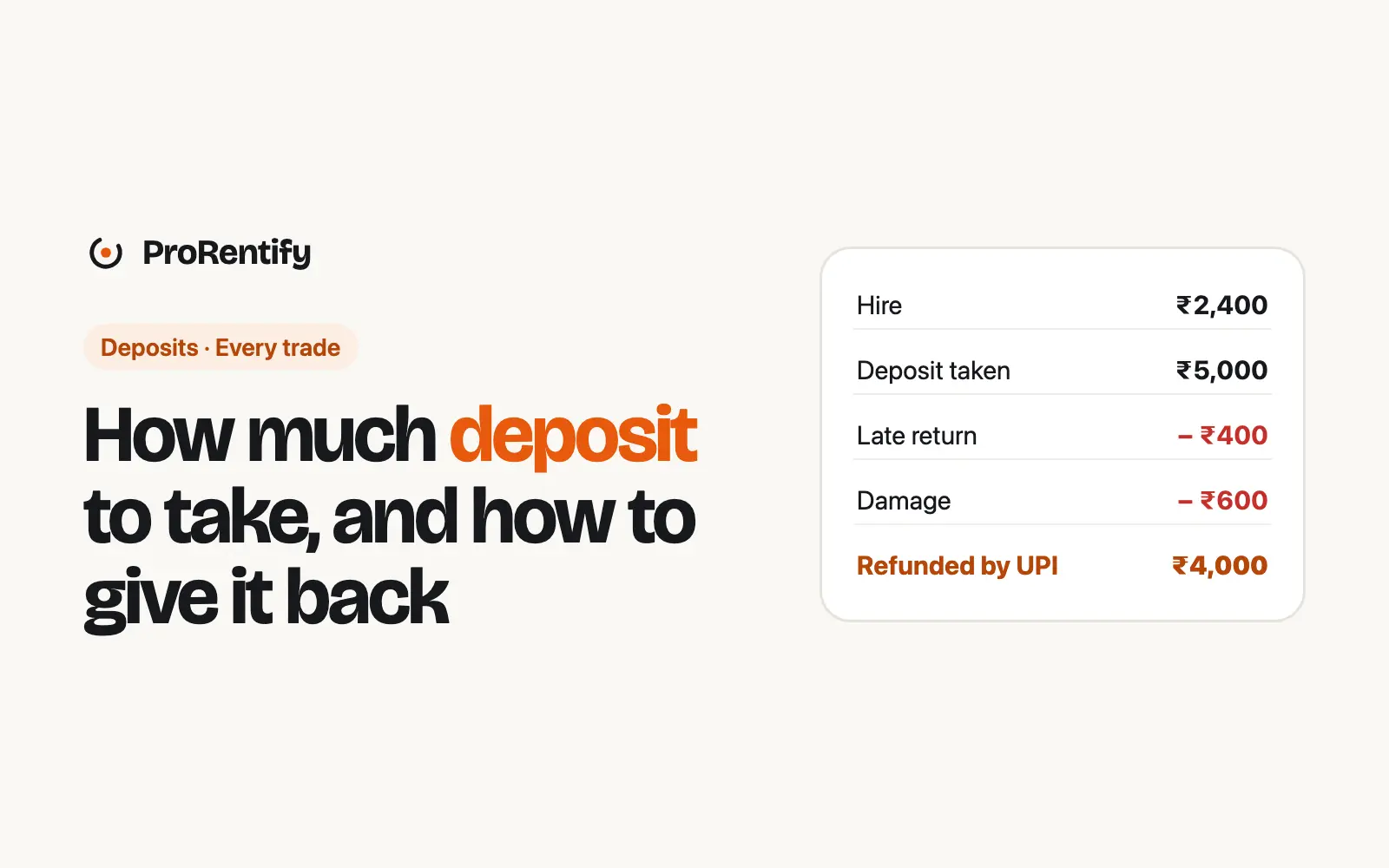
Take an advance and a deposit, and keep them apart. The advance is part of the bill. The deposit is returned, less breakage and late days. Our guide to security deposits for a rental shop covers how much to take and how to settle it.
Know who you are dealing with. Take a photo ID and a local address from a new customer, and note the venue. The person who books is often not the person at the venue.
Dry before you stack. Shamiana cloth rolled up damp grows mildew within days. Leave a day between functions for washing, drying and mending, and don't promise that set in between.
Registration and GST
Rules differ by state, so treat this as a list of questions for your CA:
- Shops and Establishments registration if you have premises or staff.
- Udyam registration, free, and useful for loans.
- Local permissions. Pandals on public land, big temporary structures, loudspeakers and generators can need municipal, police, fire or electricity permission. Decide in the order who applies: you or the customer.
- GST registration once your yearly turnover crosses ₹20 lakh (₹10 lakh in Manipur, Mizoram, Nagaland and Tripura). Hire is a service, so the ₹40 lakh limit for goods does not apply. The worked year above bills about ₹8.4 lakh.
- GST rate. A tent put up and run by your team is generally taxed at 18%. Bare hire of items, with no staff, generally takes the rate that applies to selling those goods, so it can differ by item. Outdoor catering bundled with a tent has its own rules.
- Composition. Small service providers with turnover up to ₹50 lakh may be able to pay 6% instead. You then can't charge GST on the bill or claim input credit, and conditions apply. It can suit a shop whose customers are families; companies usually want a GST invoice.
Keeping the dates straight
Most tent houses run on a diary, WhatsApp and memory. That works until two families want the same Saturday. Three things go wrong first:
- The same 150 chairs promised twice, because one booking was in the diary and the other in somebody's phone.
- Stock counted as free when it is still at yesterday's venue, or drying.
- Nobody can say what is still out, so the last few chairs are never chased.
Our comparison of notebook, WhatsApp or rental software explains when a diary stops being enough. ProRentify's event and equipment rental software handles those three:
- Quantities by date. A booking takes as many pieces as it needs from what is free on those dates, and one that would go over is refused when you confirm it.
- Time between functions. Set a turnaround for the whole shop, or a different one per product, so a shamiana set can't be booked while it dries.
- Per-hire, hourly, daily or weekly prices, set on each product.
- Partial returns. Mark each piece fine, damaged or not back. What hasn't come back stays on the booking, and the deposit isn't settled until everything is home. A damaged piece is held off the shelf.
- Deposits as a fixed sum, a share of the hire total, or a share of the items' deposit values, with damage and late charges taken out at the return.
- Photos at handover, kept with the booking.
One tip specific to tent houses: stock in sets, not singles. ProRentify gives every piece its own code, and plans count pieces, so 200 chairs entered singly is 200 items. Make "Chairs, set of 25" the product and own eight of them. Counting eight sets at the venue is faster than counting 200 chairs, the return screen has at most eight rows instead of 200, and a damage charge can go on the set. The trade-off: a set goes out whole, so count inside each one on its way back. The free plan is sized for trying a whole hire; a working tent house will need a paid one. Pricing shows what each plan holds.
A first-month checklist
- Call five local tent houses and write down their rates, with and without setup.
- Decide: bare hire, or setup too? Line up labour for wedding dates before you buy stock.
- Buy for one 150-guest function and keep the bills.
- Mark every set with a code and paint your shop's name under the chairs.
- Print an order form with hire dates, what's included, replacement rates, advance and deposit.
- Note this season's wedding dates and block drying days after each.
- Make an agreement with two other tent houses to sub-hire from each other.
- Write down every booking you turn down, with the date and the size. That list tells you what to buy next.