How to start a bike rental business in India: licence, cost and profit per bike
The licence you need under the Rent a Motor Cycle Scheme, what five scooters cost, how to price per hour, day and month, and what one bike really earns once insurance, servicing and depreciation are counted. Plus the paperwork that protects you from damage and challans.
· 10 min read
On this page
Start small and legal: a bike rental business in India needs a licence from your State Transport Authority under the Rent a Motor Cycle Scheme, 1997, which asks for at least five bikes on permits, each with comprehensive insurance and a fitness certificate. Expect ₹4–6 lakh for five scooters with insurance and setup. A scooter at ₹400 a day earns its keep only once it is out about 15 days a month; below that, each bike loses money. Profit comes from keeping bikes on the road, not from the daily rate.
The licence: Rent a Motor Cycle Scheme, 1997
Renting out motorcycles and scooters for people to ride themselves is regulated. The Central Government made the Rent a Motor Cycle Scheme in 1997 under section 75 of the Motor Vehicles Act, and it still sets the ground rules. The scheme itself is short, and these are the parts a shop owner has to know:
- No licence, no business. Paragraph 3 says nobody may run the business without a licence under the scheme.
- Who grants it. You apply in Form 1 to the State Transport Authority for the area where you live or have your main place of business. The scheme sets the fee at ₹1,000; check your state's current fee at the RTO.
- At least five bikes. The authority checks that you keep at least five motorcycles covered by permits (under section 74(1) of the Act), with comprehensive insurance, valid fitness certificates and motor vehicle tax paid. In practice that means your bikes are registered for commercial use, not on private registration.
- Premises and a phone. It also checks that you have a place to house, maintain and repair the bikes, a reception room, a phone answered day and night, and the money to keep the fleet running.
- Five years. A licence lasts five years from grant or renewal.
- Records. You must keep a register with a page for each vehicle (Form 3), and a separate register for foreign nationals (Form 4). You must also display the licence and keep a numbered complaint book and a suggestion box.
The licence can be suspended or cancelled if you break those conditions, keep bikes that do not meet the rules, or a staff member misbehaves with customers. Appeals go to the State Transport Appellate Tribunal within 30 days.
Electric scooters. A 2021 amendment exempted battery-operated motorcycles (and ones running on methanol or ethanol) from needing a permit to be rented. That makes an electric fleet simpler, but it does not make it rule-free. Ask your RTO what it still expects.
States add their own rules. Tourist states in particular enforce rental rules hard and crack down on private-plate bikes rented out on the side. Before you spend anything, visit your RTO with a list of the bikes you plan to buy and ask exactly what they need. Rules can tighten at short notice, so ask again before each renewal.
Beyond the transport licence you will need the usual shop basics: a proprietorship or partnership, a current account, Udyam registration if you want it, and GST registration once your turnover crosses the threshold (₹20 lakh for most services, ₹10 lakh in special category states). Ask a CA which GST rate applies to hiring out your vehicles, and keep their answer in writing.
What to buy first
Buy for your town's riders, not for your own taste.
- City and college towns: 110–125cc gearless scooters. Everybody can ride one, they are cheap to service, and they rent by the hour as easily as by the month. Monthly hire to students and new joiners is steady money.
- Tourist towns (Goa, the hills, Rishikesh, coastal Karnataka): scooters for most visitors, plus a few 350cc bikes for riders who want the open road. The 350s earn two to three times a scooter's daily rate but cost far more to buy and repair.
Buy the same model where you can. One model means one set of spare parts, one mechanic who knows it, and any bike can replace any other when one breaks down.
A rough start-up budget for five scooters. A new 110cc scooter costs roughly ₹85,000–1,10,000 on the road (get your dealer's quote, and ask about the commercial registration). Five bikes come to about ₹4.5–5.5 lakh. Add commercial insurance (one rental operator puts it at ₹6,000–10,000 per bike per year), helmets for riders and pillions, a few weeks' rent on a shop with parking, and money set aside for the first repairs. Buying second-hand cuts the cost but adds breakdowns. If you do, buy from one source and get every bike serviced before it goes out.
How to price
Most shops price by the day, with cheaper rates for longer hires:
- Hourly for city errands and short rides, often with a two- or four-hour minimum.
- Daily as your main rate. Published rates for a 110cc scooter run from about ₹250 to ₹400 a day in an off season to ₹600 or more in a tourist town's peak. Premium 150cc bikes and 350cc bikes rent for more, and one operator lists ₹900–1,500 a day for a 350.
- Weekly and monthly at a discount, because a bike out for a month is a bike you don't have to rent again every morning.
Look up what the three nearest shops and the big apps charge for the same model, and price within that range. You won't win on price against an app. You win on the bike being ready, clean and fuelled when the customer arrives.
Write down your rules on fuel (most shops say "return at the level you got it"), kilometres (some cap a day at 100–150 km and charge extra beyond), helmets, and late returns. Tell every rider before they leave, not after.
What a bike really earns each month
Vendor blogs often show a ten-bike fleet earning ₹50,000–80,000 a month. Those figures assume bikes are rented about 21 days of every month and that running costs are 40% of revenue. Here is the same sum done per bike, with depreciation included, so you can put in your own numbers.
One scooter bought for ₹1,00,000, rented at ₹400 a day:
| Monthly cost per bike | ₹ |
|---|---|
| Commercial insurance (₹8,000 a year) | 670 |
| Servicing, oil, tyres, brake pads (average) | 800 |
| Washing and cleaning | 300 |
| Share of shop rent and one helper (₹25,000 over 10 bikes) | 2,500 |
| Depreciation (sold for ₹40,000 after 3 years) | 1,670 |
| Total | 5,940 |
| Days rented in the month | Revenue | Profit per bike |
|---|---|---|
| 12 (quiet month) | ₹4,800 | –₹1,140 |
| 20 (good month) | ₹8,000 | ₹2,060 |
| 24 (peak) | ₹9,600 | ₹3,660 |
At ₹400 a day the bike breaks even at about 15 days. At 20 days, ten bikes make about ₹20,600 a month after setting aside money to replace them. That is a real business, but a modest one. Monthly rentals, peak-season rates and a few higher-earning bikes push it up. Accident repairs and theft push it down.
Three things move the number most:
- Days out. Every idle day is lost money. Chase repeat customers, list on maps, partner with hostels, PGs and hotels, and run monthly plans in the slow season.
- Downtime. A bike in the workshop for a week loses a quarter of its month. Service on a schedule, not when it breaks.
- Resale. A bike kept clean and serviced sells for more. That is your depreciation line.
Paperwork that protects you
Most of a bike rental shop's losses come from three things: a rider you can't trace, damage nobody recorded, and a challan that turns up a month later. The scheme's own register (Form 3) asks for most of what you need anyway:
- The rider's driving licence: number, issuing authority, the class of vehicle it covers, and the expiry date. Check that the class covers the bike, and refuse a rider whose licence has expired. Form 4 adds passport details for foreign nationals.
- Name, full address and phone, ideally with a second ID such as Aadhaar or voter ID. A photo of the document is enough. You don't need to keep anyone's original, and an original in your drawer is one more thing you can lose.
- Which bike, when it went out, when it came back, and the kilometres ridden.
- The bike's condition at handover: photos of every side, the fuel level and the odometer, taken with the rider standing there.
Then a one-page rental agreement, signed at the counter, that says:
- the deposit, and what can be taken from it (damage, late fees, fuel, unpaid rent);
- that traffic and camera challans during the hire are the rider's to pay. Camera challans go to the vehicle's registered owner, which is you, and often arrive weeks later, so keep the rider's details for long enough to recover them;
- the helmet rule (riders and pillion riders must wear helmets under the Motor Vehicles Act) and that the shop hands over a helmet with the bike;
- what happens after a breakdown or an accident: call the shop first, don't get it repaired anywhere else;
- the late-return charge, and from what time it starts.
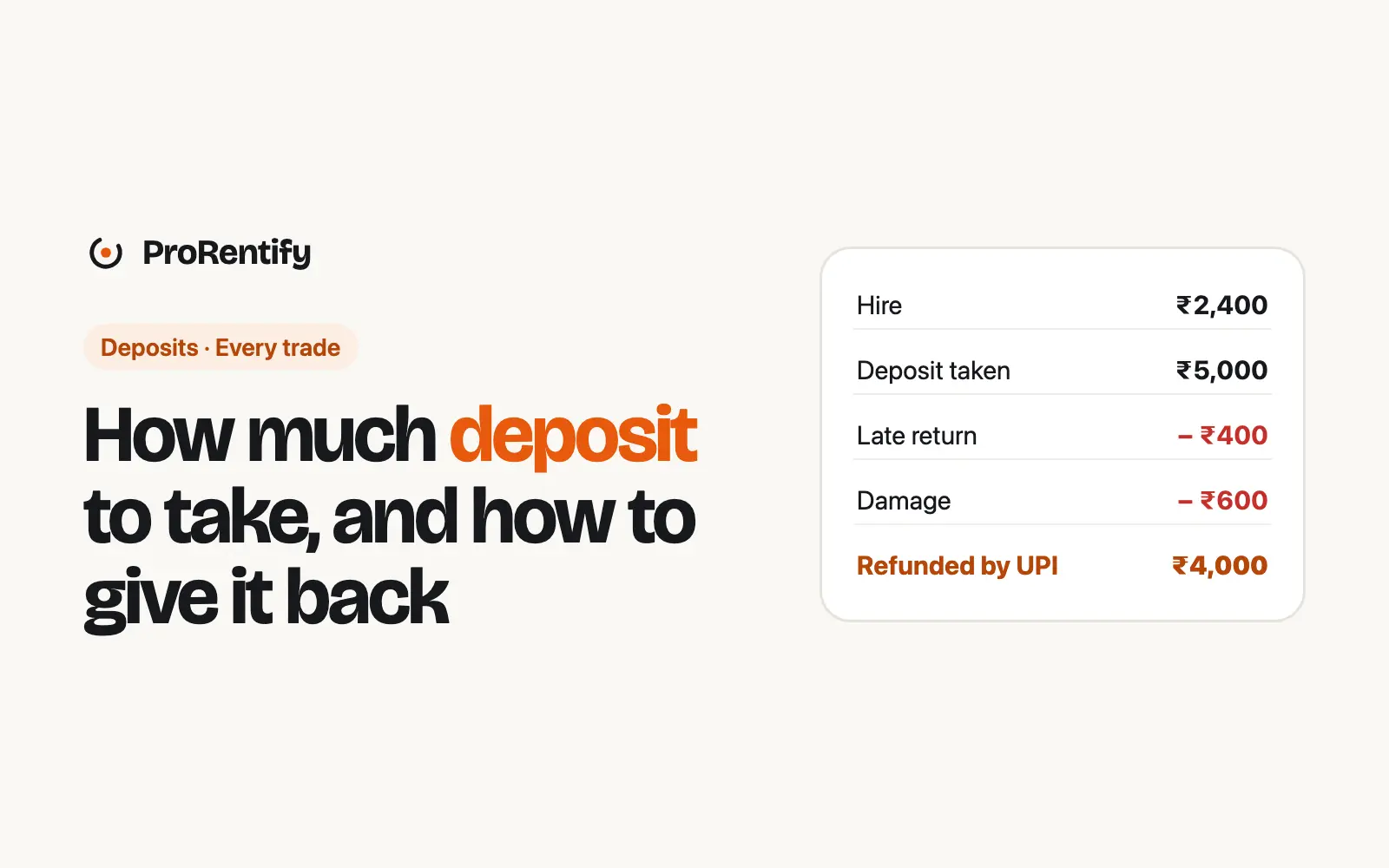
Deposits. Many scooter shops take ₹1,000–5,000, with more for 350cc bikes and long hires. Some app-based rivals advertise "no deposit". You can match that for repeat customers you know, but a first-time walk-in should leave something. Our guide to security deposits for a rental shop covers how much to take and how to settle it fairly at the return.
Running the fleet day to day
A notebook works for three bikes. By the time you have ten, with hourly and daily and monthly hires mixed together, it breaks in predictable ways: two riders promised the same scooter for Saturday, a bike handed out still muddy from the last hire, and a "back by six" that nobody chased. If that sounds familiar, read notebook, WhatsApp or rental software for how to tell when you've outgrown the book.
ProRentify's bike rental software was built for exactly this:
- Every bike has its own code, so you book the actual scooter, not "one Activa". The system refuses a booking that would overlap a bike that is already out.
- Hourly, daily or weekly pricing per bike. An hourly hire is timed from the minute it starts.
- A buffer between hires (an hour by default for bikes, which you can change) so a returned bike can be checked and washed before the next rider.
- Rider details on file: the ID type (driving licence, Aadhaar, voter ID or passport), its number and photos, kept privately with the customer.
- Handover photos at pickup and return, so the scratch argument is settled by a picture.
- Deposit and late fee at the return. The late charge is worked out from the bike's own rate after your grace period, and it can be taken from the deposit, with the refund method recorded.
- Breakdowns: swap the rider onto another bike on the same booking, and mark the broken one damaged so it is held off the road until it's fixed.
- Email reminders (on the paid plans) to riders before pickup, before the bike is due back, and when it is overdue.
There is a free plan for trying a full hire from booking to return, and paid plans as the fleet grows. See pricing.
A sensible first year
- Visit the RTO and get the licence and permit requirements in writing before buying anything.
- Start with five to eight of one scooter model, insured for commercial use.
- Write your rules (deposit, fuel, kilometres, helmet, late fee, challans) into a one-page agreement.
- Photograph every bike at every handover.
- Track days rented per bike every month. Any bike under 15 days is costing you money, so fix its price, its listing or its condition, or sell it.
- Add bikes only when the ones you have are out 20 days a month.
Get the licence right and keep the bikes on the road, and a small fleet pays for itself.